CharlieMoger.com

Marketing and advertising advice for owner-operated businesses

  • Home
  • About me
  • My work
    • MogerMedia
    • Wizard of Ads
  • Contact

Curse of the Mogul

The media emperors’ lack of wardrobe has come one step closer to the light with the release of a new book. Not only is the model broken, but its very foundation is faulty, according to author  Jonathan A. Knee, an investment banker and media professor.

“The four pillars of media conventional wisdom have not changed: First, growth at all costs; second, content is king; third, the answer to all problems is to expand globally; and finally, that by embracing convergence and the Internet, they will be able to solve all their problems,” says Knee.

The Curse of the Mogul: What’s Wrong with the World’s Leading Media Companies by Jonathan A. Knee, Bruce Greenwald, and Anna Seave, lays bare the distorted correlation between growth and value. Anyone who’s worked in the industry knows the ready-fire-aim mentality of those chasing the fatted calf of convergence. Find a deal. Make a deal. Figure out how to make it work.

Many a great company lays shipwrecked on the rocky coast of profitability because they followed that siren song. Here’s the worse part: Knee doesn’t see that trend reversing–or slowing. Read more.

Investing effort vs. spending time

ClockXCU_keyhole

They look alike. They sound alike. But, they don’t act alike. Knowing the difference between customers and clients is knowing the difference between investing effort and spending time. I’m assuming you’re interested in building long-term, professional business relationships. Think of client relationships as the bricks in your business building effort. Customer-driven businesses, on the other hand, are more like tents on a hillside.

The dividing line between customers and clients

Customers pay you to do.  Clients hire you to be. Customers seldom ask your help being anything except who they already are.  In fact, customers value your expertise only to the degree you contribute to a plan of their making. Work another person’s plan and any success is theirs. You get paid. They get success.

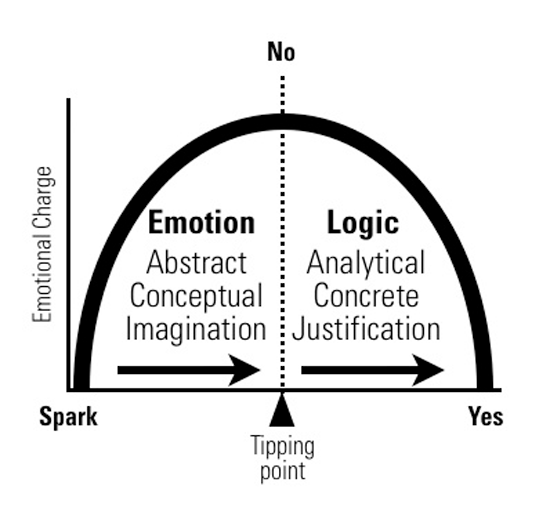
Beingness precedes doingness. You will never do anything without first seeing yourself doing it. You have to believe before you can do. Believing is abstract, conceptual, and resides in the mind. When being crosses into the concrete it becomes doing. The idea has form and is growing in justification.

Clients seek you out while still in the domain of beingness. When you’re called to DO, you’ve arrived after the thinking is done. You’re a vendor, a resource fulfilling what is already underway. No worries, though. There’s a road back to being. More on that in a moment.

Which side of the arc are you working?

Decision Arc is a tool I developed to ascertain whether we’re on the doing side for a customer or the being side with a client. There are quantifiable indicators that ring true every time.

MGM-Decision-Arc

When the conversation is about a specific solution, you’re doing. When the conversation is about deadlines and timetables, you’re doing. “We want to do a billboard,” they say. What you need to hear is “we’ve done all the thinking and need you to DO this.”

The road from being to doing leads through no

Think about the last significant decision you made. Before you took action, you had to convince yourself it would work. You had to pass through no to reach yes. You crossed over the decision arc.

When a possibility sparks your thinking, it’s only an idea. Nothing happens until you see yourself doing it. Your emotional involvement then increases as you rise in the beingness of the outcome ultimately breaking through the NO barrier.

Whether you call an ad agency or house painter in this frame of mind, you’re a customer. The deeper you go into the doingness of something, the less interested you become in alternatives. You’re only seeking the best route to done.

Sliding toward yes, you burrow into  doingness. You gather information. You shop for prices. You compare options.  The decision is made, you’re just figuring out how you’ll DO it.

If that’s how customers come to you, be afraid. A decided customer is a volatile thing. They may just as easily explode into buying behavior elsewhere. I’ve discovered a way of redirecting customers back into being with one single word.

The easy ride is to merely execute and move along. It’s also a downhill ride for your relationship with a client. Professionals have clients. Wal-Mart has customers.

Your road back from doing to being

One word puts you back into the beingness of an idea and opens the door to a client conversation with a customer. That word is WHY?

A billboard? Why? Cancel television? Why?

WHY is your trusty ally when a client veers into customer-think. A note of caution: you’re not asking to challenge. Ask to better understand. Demanding justification is a storm-trooper assault on their thinking. Seeking understanding is a slide toward alignment of thinking. The better you understand, the better you can do now and grow later.

You may  still wind up doing in this case, but you’ve gained understanding into the customer’s client thinking and demonstrated an interest in their well-being. Equipped with this access, you’re on the road to the being side of their future rides across the decision arc.

Seth Godin’s hierarchy of success

I run my business on an inviolable rule: why precedes how. You must nail the beingness of an outcome long before embarking on the doingness of getting there. Seth nails it:

Tactics tell you what to execute. They’re important, but dwarfed by strategy. Strategy determines which tactics might work.

Read more.

Cast a wide creative net with Crowdsourcing [UPDATED]

Peperami-Animal-001Step out onto a street corner. Hold up a sign with a work assignment. Passersby offer solutions. You pick one and use it. Do that on the web and you’re crowdsourcing. Anyone can play. You pick the winner.

Crowdsourcing recently brought a 16-year gig to an end for Lowe, a major UK ad agency. Their client, Uniliver, decided to cast their fate with the crowd. They’re soliciting the public for a creative way of promoting Peperami in exchange for a $10,000 prize.

You may already be participating in crowdsourcing. If you’ve purchased a stock photo online, bought tickets from Hotwire, or shopped on ebay, you’re in the crowd; searching a site for goods provided by an unseen crowd of providers.

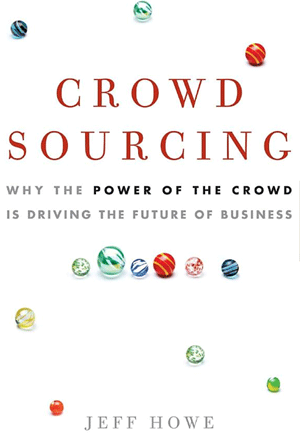
If anyone’s defined Crowdsourcing, it’s Wired Magazine’s contributing editor, Jeff Howe, author of Crowdsourcing: Why the Power of the Crowd Is Driving the Future of Business:

“Crowdsourcing is the act of taking a job traditionally performed by a designated agent (usually an employee) and outsourcing it to an undefined, generally large group of people in the form of an open call.”

Google is now using crowdsourced surface street traffic data. By turning on the crowdsourcing function of GoogleMaps on your smart phone, you become part of the traffic data crowdsource.  Google admits it will take widespread participation before the data becomes reliable.

ADM-w_CrowdCoverHowe believes Crowdsourcing is driving the future of business. But, it has limits. For instance, The Washington Post reports how recent efforts to crowdsource a restaurant served up mixed results; evidence some things are not meant for the crowd.

Ready to call on the crowd?

Before leaping to crowdsource an assignment, be warned: getting what you want requires the ability to explain the assignment in the providers native language. Do you speak Artist? Designer? Writer? Results vary based on this one factor: if they can’t see what you want, chances are you won’t get it.

Crowdsourcing works best when you can so clearly define your objective the crowd not only understands, but self-selects down to the competent few capable of delivering. If you’re vague, you’ll wind up wasting time wading through unusable submissions.

The two leading sources for design crowdsourcing are crowdspring and 99Designs. I’ve used 99Designs and found the work far exceeded my expectations. However, it taught me the time-saving importance of defining the assignment clearly. While I’ve not used them, Crowdspring was the first into is another resource in the space with a well-earned reputation. Testimony to the effectiveness of crowdsourcing: Jason at 99Designs tells me crowdspring crowdsourced their logo via 99Designs.

Crowdsourcing will demand a higher level of your involvement than calling in a trusted single vendor or staff person. Effectively using this approach has a learning curve to it–more time invested. Over time, though, effective use of crowdsourcing will net you a fresher perspective than possible with traditional talent pools.

Crowdsourcing won’t win you any designer friends. Some see perils in the process. When Forbes published their profile on crowdspring, it triggered over 100 responses, most of which I wouldn’t repeat in mixed company. Here’s a relatively tame example:

“If 100 designers enter work, 99% get screwed out of their time. From the clients perspective, he can hire staff of 100 designers for 2 bucks an hour. It should be illegal.“

The point is well-taken. Regardless of what you’re crowdsourcing, do so with integrity:

  • Make a precise request.
  • Offer a fair reward.
  • Narrow to a few finalists.
  • Be reasonable with revisions.

Understand that while it’s finished product to you, but it’s time and treasure to them.

Crowdsourcing may not drive the future of business entirely, but it provides an alternate route to fresh solutions for selected applications in businesses of every size.

  • « Previous Page
  • 1
  • …
  • 21
  • 22
  • 23
  • 24
  • 25
  • …
  • 44
  • Next Page »

Your intrepid correspondent

I head both MogerMedia, Inc. and Wizard of Ads Gulf Coast, based in Houston, Texas. We develop winning advertising strategies and creative for the best clients on earth.

Grooveyard of posts past

Copyright © 2026 MogerMedia, Inc.