CharlieMoger.com

Marketing and advertising advice for owner-operated businesses

  • Home
  • About me
  • My work
    • MogerMedia
    • Wizard of Ads
  • Contact

Online advertising in a magazine?

A magazine that updates scores. Ads showing a car driving down the road and, at a touch, reveals specs and customized pricing. News stories that link to background information. Meet the coming face of interactive magazine publishing . Are your online advertising best practices ready for this new technology?

Check out examples interactive advertising in a magazine being developed now. Look past the corpo-speak and see the future of how your customers will be consuming information in the near future. Near as in when the iPad comes out.

Don’t think this advance is way off or reserved just for the big boys. The ability to create this kind of interactive advertising will come to the local level quickly. How can you prepare? Here are three things you can do now:

Give your banners muscle

Consider how you currently execute banner advertising. If your ad simply transports a reader to your home page, you’re missing out. The shortest path to conversion is relevant results; a click is my question, where you take me is the answer.

Instead of just bringing visitors to your home page, choose specific points of your banner ad to bring visitors relevant points on your site. Click on the product, you’re taken to that specific product’s page. Click on copy in your ad and it brings you to an expanded version with more information. The company logo in an ad on the sports page takes visitors to a landing page written for sports-minded customers.

Whether you’re paying by click or impressions, the more efficiently you resolve each click, the more likely you’ll convert visitors into customers. It starts by answering the questions customers are really asking (not the ones you want them to ask) quickly and efficiently.

Show don’t tell with video

Video brings visitors into your business in a way words alone can’t. It’s a form of interactive advertising that communicates differently than cable or TV video; don’t consider using your TV spot on your site as having video. In fact, TV spots on websites can create a conversational disconnect.

Web video works best when it’s person-to-person conversational. Grab a Flip Video camera and welcome a customer as you would when they come into the store. Interview some of your customers. Don’t worry about making it pretty; the more authentic is looks, the more believable the message.

Engage visitors in conversation

Creating polls or surveys is an easy way to solicit customer input and generate better engagement. Survey Monkey gives you the ability to conduct live polls of your web visitors and display ongoing results live. Your online advertising immediately appears more connected and customers gain a greater sense of involvement.

You may get some poll results you don’t like. If you have a product or service customers aren’t happy with, they’ll tell you. That’s a good thing. If they’re already unhappy, at least now you have a way of addressing it with them and in front of everyone else. You’ll just have to walk your customer service talk.

Advantage goes to the prepared

Not only will making these adjustments enhance the effectiveness of your online advertising now, but when time comes for interactive media in dynamic publications, you’ll already have the necessary best practices in place.
My iphone app: portable advertising & marketing advice

A whole computer that fits in one room. When I was a kid, it was hard to believe computers could get that small. My kids can’t believe they were ever that big. Today, mobile computing is taking things a giant leap smaller.

Remember when having a fax was a big deal? How about email? Your next step: a own mobile app of your own. I created the adMISSIONs iPhone app on my own in less than 15 minutes using about that many clicks. Why does it matter? It’s all about service and credibility.

The mobile battlefield

The mobile screen is a growing battleground for your customer. Already there are applications to scan the bar code or take a picture of a product in your store and compare its price at stores nearby and on the web. If you expect me to buy it from you, there better be a reason beyond price.

Gone are the days of Name That Tune in my family. My son and I reach for our iPhones and Shazam tells us the name of the song, the artist, album and where we can buy it right now. Last weekend I heard a perfectly restored recording of Edith Piaf singing La vie en rose. It was on my iPhone before the song was over.

What an app really gives you

While having the adMISSIONs iPhone app in the app store gives me a chuckle, having one of your own gives your brand something important: parity. There are God only knows how many apps in the iPhone App store. Your app stands shoulder-to-shoulder with every one of them. And, you stand shoulder-to-shoulder in customer perception too. According to AdAge, major magazine publishers see apps as a way of drawing eyes back to their magazines. So, why shouldn’t they draw them to you?

REI, a customer service hero of mine, has two iPhone apps. Pizza Hut and Starbucks have apps for ordering from your phone. Southwest Airlines has one that pings every time there’s a ticket deal. CNN pushes alerts for breaking news. ESPN will alert me if the Astros win the pennant. (I’m taking their word for it on that one in lieu of demonstrable team performance.)

In their hand or out of mind

The point is, a mobile app puts your service promise and product knowledge in the hands of customers anywhere they go. Since getting your app set up is so easy, what’s stopping you? I created mine with AppMaker. Or, if you want to create an app for multiple mobile platforms, check you MotherApp. Follow the link and stake your turf on the technological frontier of customer service.

Housekeeping note: The Wednesday Weekly Reader is moving. It is now the Friday Reader. Gathering a week’s stories and providing them as a summary at the end of your week makes more sense than doing so in the middle.

Thanks for reading adMISSIONs.

Marketing Scott Brown: social media lessons to help you win

His January 19th win shocked the political world, but Scott Brown’s victory came as little surprise to marketing experts tracking social media numbers.  Scott Brown’s historic success demonstrates how social media’s underlying principles of human behavior can help you win customers.

What social media reveals quickly

Traditional polls were all over the map in the Massachusetts campaign’s final days. But, social media numbers tabulated by the Wordstream Internet Marketing blog turned out to be the most accurate in predicting the election’s outcome. What if you had this kind of advantage in your business?

Scott Brown’s social advantage over Martha Coakley
  • 10:1 advantage in web traffic
  • 10:1 advantage in YouTube viewership
  • 3:1 advantage in twitter followers
  • 4:1 advantage in Facebook followers

Democrats had dominated the web since Howard Dean made revolutionary use of it during his presidential run. But, the technical edge is narrowing. Last month, for example, Republican congressmen sent out 529% more tweets than their Democrat counterparts. Recently, 500 conservatives gathered with Newt Gingrich for workshops on effective use of social media. Here’s the catch: it takes more than a flurry of activity to drive success in politics or business.

Mark Senak, a Democrat, theorizes in his report “Twongress: The Power of Twitter in Congress,” that Democrats are paying less attention to resources that proved critical to Obama’s win even as Republicans make significant gains. Nothing creates results like sustained effort. In social media, competency in doingness is often mistaken for mastery of beingness. True success is less about what you do than who you are; social media just exposes the truth more quickly.

How do you campaign for customers?

Scott Brown’s win had less to do with social media than how he connected with something deep in the hearts of voters: they wanted to be heard. He looked them in the eye and said, “you’re not just another brick in the wall.”

As my partner Roy H. Williams says, he “spoke to the dog in the language of the dog about what’s in the heart of the dog.”

That’s connecting with a true felt need. Comparing how Brown and Coakley were able to “speak dog”   offers clues for how you can better connect with your customers.

Be different where it counts

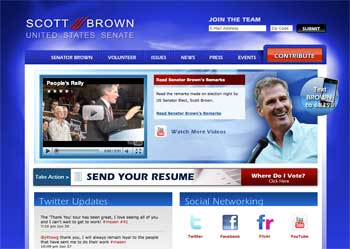
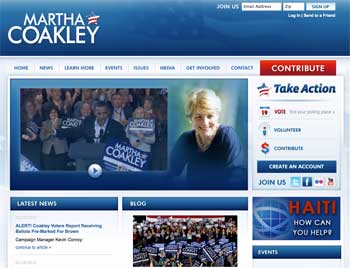
While both candidates reached out via traditional and social media, Scott Brown did it better. Compare their websites. Brown’s social media elements jump out, as do ways to get involved. Coakley’s links are lost in a traffic jam of graphics.

Other subtle differences: Brown’s blue is deeper, more pure.  Coakley’s blue seems pale by comparison. Pure is strong. Pale is weak.

Brown’s photo is an action shot taken from a low angle; you look up at him. He seems bigger than life. Coakley’s is a posed portrait shot from a high angle; you look down at her. She is diminished. Up is good. Down is bad.

Brown’s video shows him campaigning. Coakley’s video is Obama campaigning. Brown is engaged. Coakley’s along for the ride.

Doing little things right gets big results

While such distinctions seem small, they send a message to customers. Your marketing, especially your social media, will be successful only to the degree you’re willing to authentically connect with your customer’s felt need.

Saying you’re connected and demonstrating it are different matters. Being real demands sustained effort to create trust and credibility.Voters and customers can smell a fake even over dial-up. Twittering once every week or so is worse than not doing it at all. Ditto with intermittent blog and Facebook posts.

Social Media opens a door; what you do with it determines if anyone comes in. Whether they stick around is a reflection of how real you’re perceived as being.

Whether it’s social media, traditional media, or person-to-person interaction, since time began, all people want is connectedness, recognition, and appreciation.  Scott Brown was able to provide that. Martha Coakley didn’t.

Which campaign trail seems a better path for you?

Getting more from what you give

WEDNESDAY’S WEEKLY READER

Food for thought gathered from around the web and served fresh to you.

Food for thought gathered from around the web and served fresh to you. This week: How to build a better social media following, what makes content to boost your credibility, why the yellow pages aren’t dead yet, and a look back at Super Bowl ad winners and losers.

Your following equals your giving

Brand marketers want consumers to follow them to build buzz and engagement, but social media users often desire something in return. What they’ve come to expect is a good deal, but many consumers—including the most active users of social sites—are also interested in deeper engagement.

A truth more powerful than your own

“Consumers create content for two reasons: 1. the company failed to adequately answer the questions they have and/or 2. they’re excited (positively or negatively) about the company’s offering,” says Bryan Eisenberg. That’s why consumers are more credible than the company. It is only because companies have spent so many years hyping up their “value” that the consumer B.S. meter has gone into overdrive, and we count on advice from others like us that we can trust.

Rules for ideas worth spreading

Here’s a bonus gem: Seth Godin’s random rules for ideas worth spreading. My personal favorite: “Are you a serial idea-starting person? If so, what can you change to end that cycle? The goal is to be an idea-shipping person.” Which are you?

Tradition teetering on irrelevance?

Every year, a new telephone book, usually weighing a few pounds, lands with a thud on my front steps. While it’s estimated to consume millions of trees a year to produce, the question is: who uses it? Since most Americans now carry mobile phones, do we still need printed phone directories?

How many winners will play Super Sunday?

It’s not just the most-watched television event of the year; it’s also the one day when people actually sit down in front of the TV specifically to watch the commercials. The pressure to be among the best — or most noticed — has led to some of the biggest fumbles in advertising history. Thanks to the Internet, such embarrassments no longer fade away after the final touchdown.

  • « Previous Page
  • 1
  • …
  • 16
  • 17
  • 18
  • 19
  • 20
  • …
  • 44
  • Next Page »

Your intrepid correspondent

I head both MogerMedia, Inc. and Wizard of Ads Gulf Coast, based in Houston, Texas. We develop winning advertising strategies and creative for the best clients on earth.

Grooveyard of posts past

Copyright © 2025 MogerMedia, Inc.