CharlieMoger.com

Marketing and advertising advice for owner-operated businesses

  • Home
  • About me
  • My work
    • MogerMedia
    • Wizard of Ads
  • Contact
You are here: Home / Archives for Web

My iphone app: portable advertising & marketing advice

A whole computer that fits in one room. When I was a kid, it was hard to believe computers could get that small. My kids can’t believe they were ever that big. Today, mobile computing is taking things a giant leap smaller.

Remember when having a fax was a big deal? How about email? Your next step: a own mobile app of your own. I created the adMISSIONs iPhone app on my own in less than 15 minutes using about that many clicks. Why does it matter? It’s all about service and credibility.

The mobile battlefield

The mobile screen is a growing battleground for your customer. Already there are applications to scan the bar code or take a picture of a product in your store and compare its price at stores nearby and on the web. If you expect me to buy it from you, there better be a reason beyond price.

Gone are the days of Name That Tune in my family. My son and I reach for our iPhones and Shazam tells us the name of the song, the artist, album and where we can buy it right now. Last weekend I heard a perfectly restored recording of Edith Piaf singing La vie en rose. It was on my iPhone before the song was over.

What an app really gives you

While having the adMISSIONs iPhone app in the app store gives me a chuckle, having one of your own gives your brand something important: parity. There are God only knows how many apps in the iPhone App store. Your app stands shoulder-to-shoulder with every one of them. And, you stand shoulder-to-shoulder in customer perception too. According to AdAge, major magazine publishers see apps as a way of drawing eyes back to their magazines. So, why shouldn’t they draw them to you?

REI, a customer service hero of mine, has two iPhone apps. Pizza Hut and Starbucks have apps for ordering from your phone. Southwest Airlines has one that pings every time there’s a ticket deal. CNN pushes alerts for breaking news. ESPN will alert me if the Astros win the pennant. (I’m taking their word for it on that one in lieu of demonstrable team performance.)

In their hand or out of mind

The point is, a mobile app puts your service promise and product knowledge in the hands of customers anywhere they go. Since getting your app set up is so easy, what’s stopping you? I created mine with AppMaker. Or, if you want to create an app for multiple mobile platforms, check you MotherApp. Follow the link and stake your turf on the technological frontier of customer service.

Housekeeping note: The Wednesday Weekly Reader is moving. It is now the Friday Reader. Gathering a week’s stories and providing them as a summary at the end of your week makes more sense than doing so in the middle.

Thanks for reading adMISSIONs.
Marketing Scott Brown: social media lessons to help you win

His January 19th win shocked the political world, but Scott Brown’s victory came as little surprise to marketing experts tracking social media numbers.  Scott Brown’s historic success demonstrates how social media’s underlying principles of human behavior can help you win customers.

What social media reveals quickly

Traditional polls were all over the map in the Massachusetts campaign’s final days. But, social media numbers tabulated by the Wordstream Internet Marketing blog turned out to be the most accurate in predicting the election’s outcome. What if you had this kind of advantage in your business?

Scott Brown’s social advantage over Martha Coakley
  • 10:1 advantage in web traffic
  • 10:1 advantage in YouTube viewership
  • 3:1 advantage in twitter followers
  • 4:1 advantage in Facebook followers

Democrats had dominated the web since Howard Dean made revolutionary use of it during his presidential run. But, the technical edge is narrowing. Last month, for example, Republican congressmen sent out 529% more tweets than their Democrat counterparts. Recently, 500 conservatives gathered with Newt Gingrich for workshops on effective use of social media. Here’s the catch: it takes more than a flurry of activity to drive success in politics or business.

Mark Senak, a Democrat, theorizes in his report “Twongress: The Power of Twitter in Congress,” that Democrats are paying less attention to resources that proved critical to Obama’s win even as Republicans make significant gains. Nothing creates results like sustained effort. In social media, competency in doingness is often mistaken for mastery of beingness. True success is less about what you do than who you are; social media just exposes the truth more quickly.

How do you campaign for customers?

Scott Brown’s win had less to do with social media than how he connected with something deep in the hearts of voters: they wanted to be heard. He looked them in the eye and said, “you’re not just another brick in the wall.”

As my partner Roy H. Williams says, he “spoke to the dog in the language of the dog about what’s in the heart of the dog.”

That’s connecting with a true felt need. Comparing how Brown and Coakley were able to “speak dog”   offers clues for how you can better connect with your customers.

Be different where it counts

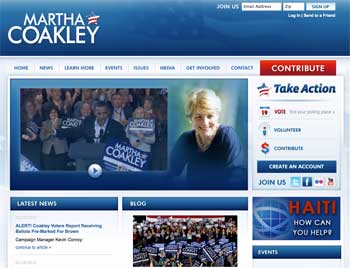
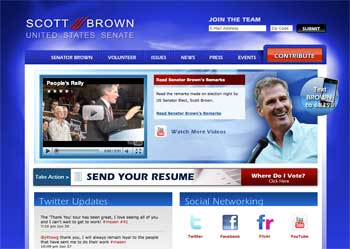
While both candidates reached out via traditional and social media, Scott Brown did it better. Compare their websites. Brown’s social media elements jump out, as do ways to get involved. Coakley’s links are lost in a traffic jam of graphics.

Other subtle differences: Brown’s blue is deeper, more pure.  Coakley’s blue seems pale by comparison. Pure is strong. Pale is weak.

Brown’s photo is an action shot taken from a low angle; you look up at him. He seems bigger than life. Coakley’s is a posed portrait shot from a high angle; you look down at her. She is diminished. Up is good. Down is bad.

Brown’s video shows him campaigning. Coakley’s video is Obama campaigning. Brown is engaged. Coakley’s along for the ride.

Doing little things right gets big results

While such distinctions seem small, they send a message to customers. Your marketing, especially your social media, will be successful only to the degree you’re willing to authentically connect with your customer’s felt need.

Saying you’re connected and demonstrating it are different matters. Being real demands sustained effort to create trust and credibility.Voters and customers can smell a fake even over dial-up. Twittering once every week or so is worse than not doing it at all. Ditto with intermittent blog and Facebook posts.

Social Media opens a door; what you do with it determines if anyone comes in. Whether they stick around is a reflection of how real you’re perceived as being.

Whether it’s social media, traditional media, or person-to-person interaction, since time began, all people want is connectedness, recognition, and appreciation.  Scott Brown was able to provide that. Martha Coakley didn’t.

Which campaign trail seems a better path for you?

Are you running for cover or running to win?

Two salesmen are sent to a newly discovered tropic island to sell shoes to natives. The first one writes back, “situation hopeless: no one wears shoes.” The second one writes, “Amazing opportunity: everyone needs shoes.”

It’s an old joke, but it illustrates the different view two companies take of yet-to-be defined land of social media. Which comes closer to reflecting your online engagement?

Clorox: call the attorneys

According to AdAge Magazine, Clorox has “taken the unusual step of advertising for a full-time in-house legal counsel to focus on social media — a rather surprising sign of how entrenched social-media marketing is becoming even for relatively established household products.”

It turns out that a survey of entries on Twitter and Facebook regarding Clorox are for off-label purposes. The possibility of such an entry causing harm and being traced back to a company employee was all it took for Clorox to prepare for the worst. There’s also the unthinkable risk of someone advancing their own interests with the unauthorized use of Clorox.

The company recently ramped up their social media efforts with creation of the Understanding Bleach blog. It’s  squeaky-clean (no pun intended) and hobbled by ad-speak and self-serving video. There’s nothing warm or human here–unless you find it amazing to learn what can be cleaned with “Clorox® Regular Bleach.”

P&G: put the best Facebook forward

That same issue of AdAge carries a story about Proctor & Gamble’s opening of an office in California’s Silicon Valley to better leverage social media–especially Facebook. The company’s goal to reach 5 billion social media consumers worldwide makes Facebook the obvious step.

“P&G sees the value of digital and social media in consumers’ lives and we want to connect with consumers in the environments where they are spending their time,” a P&G spokesperson told the magazine.

While Twitter allows what the company sees as a one-to-many vehicle more akin to television, they see Facebook as a relationship deepener. For example, Tide is offering vintage shirts for sale on their Facebook page with proceeds going to their Loads of Hope benefit for Haiti relief. The brand is plugged into what matters to their customers, allowing them to make a difference.

Clorox, meanwhile, is a sea of “we-we” that  sees the world through a lens of how their product can be used. Even as flu season abates, Clorox continues running a flu-prevention promotion that offers an in-school appearance by an American Idol finalist.

Posture drives headcount

P&G’s Tide brand alone has 310,263 Facebook fans. Meanwhile, Clorox has 69,792 fans for it’s three listings combined. The point is larger than Facebook fan counts; there is a fundamental difference in the approach used by each of the companies and it shapes the relationship being built with their customers. One sees natives in need of shoes while the other is taking precautions against getting kicked. Which approach is reflected in your advertising posture?

Social media success tastes like bacon

Justin Esch and Dave Lefko love bacon. This is a story of how conversation and social media transformed their lives. It’s a business development success story that will give pause to even the most jaundiced observer of social media.

bacon salt site

On the fence about Facebook and Twitter?
Here’s a dollars and cents example to ponder.

“Wouldn’t it be great if there was a powder that made everything taste like bacon,” Dave jokingly asked Justin one night over a beer. The two, employees of a high-tech company, took what must have seemed the next obvious step: check it out online.

A survey of MySpace users uncovered over 35,000 interested bacon taste lovers. Their experimentation and exploration (online) ultimately resulted in a product now sold in stores nationwide. Eric Qualman, in his book, Socialnomics: How social media transforms the way we live and do business, says their initial research practically pulled the product to market,

“They began reaching out to these people to gauge their interest in Bacon Salt, and not only did they find interest, they started receiving orders when they didn’t even have a product yet!”

I’m skipping a ahead (read their whole story here), but the point remains: social media transformed idle curiosity into a profitable business and made their bacon savoring dreams come true. Adding to the improbability of it all, Justin and Dave got their start-up investment when his 3-year old son Dean won $5,000 on America’s Funniest Home Videos. See for yourself:

A lesson —

What’s bacon have to do with your business?

What Justin and Dave demonstrate goes way beyond start-up success. It is a clinic on how your business can tap social media to build trust, credibility, rapport, and relationship. Consider this:

  • Their idea was authentic; they made an honest inquiry
  • They isolated and tapped into a genuine felt need
  • They crowdsourced development soliciting feedback
  • They generated demand and leveraged it at retail
  • They continue providing updates to fans: recipes, new products, etc.
  • Their transparency cements customer allegiance

What part of this can’t you do right now?

Opening yourself up to dialog has some risk; customers may vent or complain. Chances are, they’re doing so now somewhere anyway. Providing a forum and constructively responding not only neutralizes damage, but creates transparency. You also create a place to get input, share new products, and positive experiences. It’s just a matter of organization and focus. I can help you make it happen. Let’s talk.

One more lesson from the bacon boys:

There’s another tasty lesson for you in Justin and Dave’s success. They’re not just successful, they’re happy to share. How much more transparent can you get than explaining point-by-point how to do what they did; reaching up with one hand while reaching down to lift up others.

Justin and Dave are my kind of crazy.

  • « Previous Page
  • 1
  • 2
  • 3
  • 4
  • 5
  • …
  • 7
  • Next Page »

Your intrepid correspondent

I head both MogerMedia, Inc. and Wizard of Ads Gulf Coast, based in Houston, Texas. We develop winning advertising strategies and creative for the best clients on earth.

Grooveyard of posts past

Copyright © 2025 MogerMedia, Inc.